From Weld Fatigue Curves to Port Clearance—A 20-Year Analysis of Compliance Practice at Xiangyue Factory
1. Why “Load Testing” is More Than a Number—The Engineering Philosophy
1.1 Structural Deviations Between Rated Load and Real-World Conditions
- Idealized Hypotheses vs. Job Site Reality: Laboratory tests are typically conducted on epoxy floors with minimal leveling errors. However, common warehouse floor gradients (+/- 3mm/m) or expansion joints trigger instantaneous impact loads. This deviation means the peak force experienced by a frame rated at 200kg can surge significantly during actual operation.
- The Fundamental Difference Between Statics and Dynamics: Static loading only requires the equilibrium of forces (Sigma F=0). In dynamic conditions, the acceleration term (F=ma) must be introduced. When a hand truck crosses a threshold, vertical acceleration can reach 0.5g \sim 1.2g, requiring a 200kg-rated frame to withstand an equivalent impact of $300 \sim 440kg$ to prevent weld crack initiation.
- The Scientific Origin of “Safety Factors”: The 2x static load test required by ANSI MH29.1 is not an arbitrary figure; it is based on the S-N Fatigue Curve of the steel. Considering the variance in material production, a factor of 2 ensures that 99% of products will not suffer catastrophic structural failure within their intended lifespan.
- Material Resilience and Failure Criteria: The elastic modulus of Q235 steel is approximately 206 GPa. During testing, a qualified engineer must distinguish between “elastic deflection” and “permanent deformation”. If the material fails to spring back to its original position after unloading, the structure has entered the plastic deformation zone, resulting in a compliance failure.
- Legal Implications of Liability Boundaries: In North America, if a workplace injury involves material handling equipment, OSHA will trace the manufacturer’s original test records. Maintaining compliant test reports is a manufacturer’s primary means of proving “Due Diligence” in legal proceedings.
1.2 The Mechanical Roots of the 1.5x Dynamic Load Factor
- Energy Conversion to Strain Energy: Based on the energy conservation equation frac{1}{2}mv^2 = frac{1}{2}k\delta^2, when a loaded hand truck hits a 30mm threshold at a normal walking speed (1.5 m/s), kinetic energy is rapidly converted into the strain energy of the frame. Calculations show that the instantaneous impact force peak is typically 1.5 to 2.0 times the static load.
- Frequency Resonance Threats: The natural frequency of a welded frame is usually between 8 \sim 20 Hz. If floor vibrations from forklifts coincide with this range, resonance occurs, leading to early fatigue fracture at the stress-concentrated “axilla” of H-shaped frames.
- Moment Reversal During Ramp Braking: During downhill braking, the center of gravity shifts forward rapidly. This not only increases the vertical load on the front wheels by 40% but also generates a overturning moment that attempts to “twist” the vertical tubes. Standard dynamic testing must replicate these extreme load distributions.
- Bearing Thermal Runaway Warnings: Continuous heavy-load operation generates heat that can cause lubricant to reach its evaporation point (typically 120^\circ C). Lubrication failure leads to a sudden surge in friction torque and may even melt plastic rims—a failure mode that long-distance dynamic fatigue tests must monitor.
- Environmental Temperature Effects: In -30 degree cold storage environments, steel undergoes Ductile-to-Brittle Transition (DBTT). As impact toughness drops significantly, Xiangyue adjusts the dynamic factor to 2.0x for cold-chain clients to offset the risk of brittle material failure.
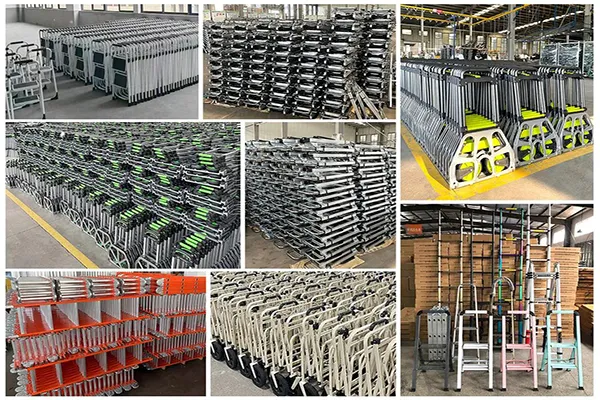
2. Itemized Breakdown of Core Testing Projects—Laboratory SOPs and Criteria
2.1 Static Load Test
- Setup Details: Hydraulic loading systems or standard weights must be used; sandbags are strictly prohibited due to their fluidity causing uneven load distribution. The horizontal deviation of the loading platform must be controlled within 0.5^\circ.
- Loading Rate Control: The loading rate must be kept within 10%/min of the rated load to prevent artificial “pseudo-dynamic shocks” caused by rapid loading.
- Pressure Maintenance and Measurement: Pressure is maintained at 2.0x load for 5 minutes. Xiangyue places strain gauges at critical nodes to monitor the stress distribution heatmap in real-time, identifying microscopic yields invisible to the naked eye.
- Judgment Criteria: Failure is determined if permanent deformation exceeds 10% of the deflection under rated load or if surface micro-cracks are observed in the welds.
2.2 Drop Test
- Physical Basis: A $300mm$ drop height corresponds to an instantaneous acceleration of approximately 50g. This destructive index is based on statistical data of “violent handling” at international ports.
- Postural Diversity: Tests must cover three postures: full-load flat drop (simulating side tip), full-load upright drop (simulating forward tip), and empty-load free fall to simulate rough stacking in warehouses.
- Process Refinement: Data showed that robot GMAW (Gas Metal Arc Welding) provides much higher impact toughness than manual welding. Since upgrading our process in 2018, the weld cracking rate in drop tests has decreased significantly.
2.3 Ramp Fatigue Test
- Cycle Life Back-Calculation: A 10^\circ ramp and 25,000 cycles are set to simulate approximately 7 full-load trips per day over a 10-year lifespan.
- Rainflow Counting Application: We convert measured load waveforms into equivalent stress amplitudes. According to Miner’s Rule, we assess the residual life of the frame under cumulative damage.
- Wheel Degradation Monitoring: We focus on monitoring the resilience of PU wheels. When resilience drops from 72% to 55%, the vibration transmitted to the frame doubles.
2.4 Handle Strength Test
- Operational Force Simulation: Using the formula Fp/Fv = tan(theta), handle tubes are tested at the most disadvantageous 45° force angle. If the section modulus is insufficient, the circular tube will buckle under a 50 N\cdot m bending moment.
- Shear Resistance Design: Handle connections utilize double-sided fillet welds (weld leg ge 5mm) to ensure that tear-type (Mode I) cracks do not occur under frequent push-pull shear stress.
- Surface Durability: After mechanical testing, a 48-hour salt spray test is performed to ensure that microscopic deformations have not compromised the powder coating, which would otherwise lead to corrosion.
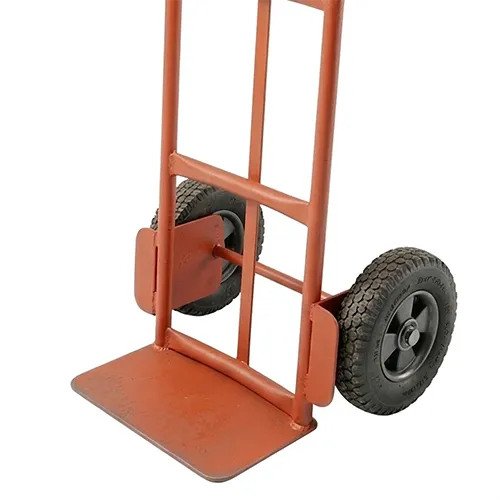
3. ANSI MH29.1 (North America) vs. EN 1757 Series (Europe)
3.1 Structural Differences in Standards
- Classification Logic: ANSI focuses on “end-use function,” classifying by load and wheel type; EN standards classify by kinematic principles, reflecting the precision of European manufacturing.
- Certification Thresholds: For the German market, the GS mark is almost a mandatory requirement, necessitating on-site audits by third parties like TÜV.
3.2 Comparison of Key Technical Parameters
- Load Factor Variance: EN standards require a 2.5x load factor for certain conditions, whereas ANSI requires 2.0x. Products designed only for North American standards may fail European testing.
- Lifespan Expectations: EN requirements for cycle counts are significantly higher than ANSI, reflecting the European market’s expectation for a 10+ year product lifespan.
3.3 Material and Process Compliance
- Chemical Regulation: Europe’s REACH/RoHS strictly limits hexavalent chromium in plating.
- Process Documentation: EN standards require technical files to be archived for 10 years. Xiangyue has established a dual paper-and-digital archiving system to meet these audit requirements.
4. Xiangyue Internal Laboratory: From Testing Data to Compliance Backing
4.1 Internal Testing Capabilities: More Than a Lab, an R&D Center
- High-Precision Static Rig: Equipped with a 50-ton hydraulic test rig and a 6-channel wireless strain acquisition system (1kHz sampling rate), we don’t just measure load; we measure “stress distribution”.
- Automated Ramp Machine: Our self-developed servo-driven reciprocating mechanism runs 24/7. Combined with infrared thermography, we capture precise bearing temperature rise curves during fatigue tests.
- Standardized Detection: Beyond mechanical tests, we standardize Magnetic Particle Testing (MT) to detect microscopic internal weld defects, ensuring every export product is flawless.
4.2 Quality Control: Turning Standards into Process Instructions
- Critical Control Points (CCP): Based on failure analysis, we’ve identified 7 CCPs on the production line (e.g., welding current, coating thickness).
- First-Article & Sampling Linkage: The first article of every batch must pass an internal reinforced load test before mass production.
- Data-Driven Iteration: All test failures enter our NCR (Non-Conformance Report) database to drive product iterations. For example, thickening our axilla weld legs in 2022 was directly driven by ramp test data.
4.3 Trade Compliance: Optimizing Logistics and International Audits
- Standardized Compliance Technical Package: For every export batch, Xiangyue provides a “Technical Package” including the final test report, Material Test Certificates (MTC), and ISO certificates. This pre-emptive documentation helps freight forwarders accurately match HS codes (e.g., 8716.80) and reduces customs queries.
- Efficient Third-Party Inspection (TPI): When clients appoint SGS or Intertek for acceptance, we prepare equipment calibration certificates and batch records in advance. Because our internal processes align with international standards, TPI (on-site) time is typically reduced to half a day, lowering client costs.
- Destination Port Support: For GS-certified batches to Europe, we ensure nameplate info matches archived technical files. If spot-checked at the destination port, we quickly provide supporting documents to overseas agents to avoid port detention risks.
- Retailer Audit Responsiveness: For audits from Walmart or Amazon, we can quickly export structured quality reports for the last 12 months. This fact-based data response builds immediate confidence in “Made in China” quality.
5. Procurement Decision Framework—Assessing a Supplier’s True Testing Capability
5.1 Checklist for Identifying “Substantial Compliance”
- Verify Sensor Calibration: Before looking at the report, check the equipment calibration certificates to ensure they are within their 12-month validity.
- Ask for “Failure History”: A real lab must have records of failures. A supplier who can honestly discuss failure improvement plans is far more credible than one claiming “zero failures”.
- Verify Welding WPS: Request the Welding Procedure Specification for that specific model to confirm the production process is controlled.
- Confirm Sample Source: Ask if the test sample was a “golden sample” or a random production sample; only the latter is statistically significant.
Conclusion: Standards are the Starting Point; Engineering Insight is the Finish Line
Twenty years ago, I first saw a weld snap silently during the 18,000th cycle of a fatigue test. That moment taught me that behind every standard number are real physical events happening in a warehouse or on a ramp. At Xiangyue, we don’t test to get a certificate—the certificate is just the result for clients and customs. What truly gives us peace of mind is that data point climbing high on the S-N curve, and that weld that remains intact after the 25,000th cycle.