
Procuring wholesale stainless steel lab carts for modern clinical distribution networks demands far more than evaluating basic dimensions, shelf capacities, and initial price points. In the high-stakes environments of sterile surgical wards, pharmaceutical cleanrooms, and diagnostic laboratories, material handling equipment is subjected to relentless sterilization protocols and highly corrosive chemical agents.
For global medical distributors and healthcare facility directors, sourcing substandard equipment is a catastrophic liability. Lower-tier trading firms frequently substitute medical-grade materials with commercial-grade 201 steel, which rapidly oxidizes, harbors dangerous pathogens, and inevitably fails critical health department inspections. In a sterile environment, rust and biological buildup are not just maintenance issues; they are severe regulatory violations that can shut down entire clinical operations.
Securing a dominant position in the medical supply sector requires bypassing intermediaries and partnering directly with an advanced OEM fabrication facility. This executive briefing outlines the strict metallurgical requirements, seamless welding processes, acoustic engineering standards, and global container logistics necessary to procure a commercial fleet. By understanding these manufacturing benchmarks, distributors can ensure their equipment delivers absolute compliance and maximum Return on Investment (ROI) for their end-users.
1. The Core Material: Why Wholesale Stainless Steel Lab Carts Require Grade 304 Metallurgy
In the realm of medical and scientific manufacturing, the term “stainless” is a spectrum, not an absolute guarantee. The foundation of any sterile-environment cart is its elemental composition, and procurement directors must verify the exact steel grading before authorizing bulk orders.
Many unverified suppliers utilize Grade 201 stainless steel to artificially lower FOB prices and increase their own profit margins. While visually identical to higher grades upon initial delivery, Grade 201 lacks the necessary nickel content to withstand harsh clinical environments. When exposed to daily wipe-downs with industrial bleach, quaternary ammonium compounds, or hydrogen peroxide vapor, Grade 201 rapidly develops micro-pitting. These microscopic pits compromise the structural integrity of the steel and create breeding grounds for bacteria.
A certified OEM manufacturer exclusively fabricates clinical fleets utilizing Grade 304 stainless steel. This premium alloy contains high levels of chromium (typically 18%) and nickel (8%). These elements react with atmospheric oxygen to form an invisible, self-healing “passive layer.” This molecular barrier renders the steel entirely non-porous and highly resistant to aggressive chemical disinfectants. When distributors order wholesale stainless steel lab carts manufactured with verified Grade 304, they are securing a product that remains impeccably sterile, structurally sound, and visually pristine for decades of continuous clinical use.
2. Eradicating Pathogens Through Seamless TIG Welding Protocols
High-grade raw materials are rendered completely useless if the manufacturing assembly process creates biological hazards. The most critical, yet frequently overlooked, aspect of a medical cart is the integrity of its weld seams.
Generic carts produced by low-tier workshops are often assembled using rapid spot-welding or overlapping joints that leave microscopic crevices. In a sterile lab, these unsealed crevices become impossible to sanitize. They act as permanent reservoirs for bacteria, mold, and healthcare-associated infections (HAIs), rendering complete sterilization fundamentally impossible.
To guarantee a 100% sterile surface area, our manufacturing facility employs precision TIG (Tungsten Inert Gas) welding. This advanced fabrication technique utilizes a non-consumable tungsten electrode to produce the weld, shielded by an inert argon gas. This allows our engineers to create continuous, deeply penetrated seams without the messy splatter associated with standard MIG welding.
Post-welding, every single joint undergoes a rigorous finishing process. The welds are mechanically ground and electro-polished until they are perfectly flush with the surrounding steel. This seamless construction eliminates all “dead corners,” ensuring that biological contaminants have absolutely nowhere to hide during rigorous hospital cleaning protocols.
3. Empirical Verification: The 72-Hour Salt Spray Benchmark
In global B2B medical procurement, marketing claims must be backed by empirical engineering data. You cannot afford to take a supplier’s word on corrosion resistance; you must demand verifiable, standardized testing to protect your distribution network from mass product returns.
The global standard for evaluating accelerated corrosion resistance is the Salt Spray Test (ASTM B117). The equipment is placed in a sealed environmental chamber and continuously bombarded with a highly concentrated salt-water fog, effectively simulating years of harsh chemical exposure and high humidity in a matter of days.
Most standard foodservice or warehouse stainless steel is only required to pass a 24 to 48-hour test. However, for equipment deployed in surgical suites or volatile chemical labs, the tolerance for oxidation is strictly zero. We push our Grade 304 fabrication batches to a grueling 72-hour salt spray benchmark. If a cart can emerge from this extreme acceleration without a single microscopic speck of rust, it is certified ready for the most demanding clinical environments in the world. Providing this level of empirical data empowers your sales force to confidently win lucrative government and hospital tenders.
4. Acoustic Engineering and Silent Clinical Workflow Design
A medical cart is a dynamic piece of equipment that operates continuously in high-stress, noise-sensitive zones. Old, squeaky metal casters or rattling shelves create severe disruptions in patient recovery wards and heavily distract technicians operating delicate diagnostic machinery.
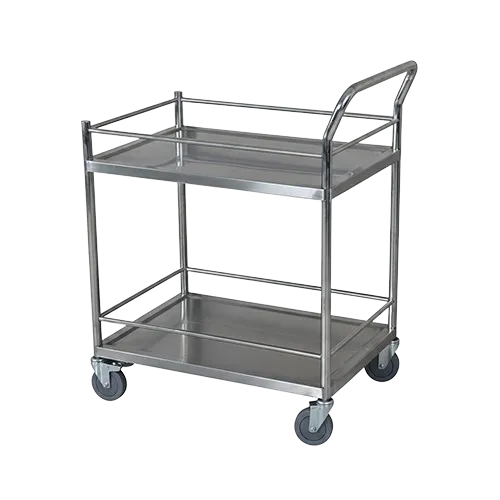
A premium fleet of wholesale stainless steel lab carts must integrate acoustic engineering directly into its structural design. Procurement directors must evaluate the specific mobility systems to ensure silent operation:
- Medical-Grade TPR Casters: Professional clinical carts must be equipped with premium Thermoplastic Rubber (TPR) or high-density Polyurethane (PU) medical casters. These advanced wheels feature double-shielded precision ball bearings that glide silently over hospital floor tiles, absorbing shock and leaving absolutely zero scuff marks in cleanrooms.
- Anti-Rattle Dampening Systems: High-end OEM facilities integrate advanced sound-dampening materials beneath the stainless steel shelving. This completely neutralizes the loud, echoing vibrations commonly associated with rolling metal equipment, ensuring a hushed, professional clinical environment.
- Integrated Workflow Storage: Models featuring precision-gliding, soft-close double drawers provide immediate, sterile storage for sensitive instruments like syringes, pipettes, or patient documentation. This drastically reduces the time staff spends moving between centralized supply closets, optimizing the daily clinical workflow.
5. Supply Chain Mastery: KD Logistics for Wholesale Stainless Steel Lab Carts
For international medical equipment distributors, the ultimate profitability of a global procurement strategy is determined by ocean freight efficiency. Shipping fully assembled, bulky metal carts severely limits container capacity. Shipping “empty air” inflates landed costs and instantly destroys your competitive pricing edge in regional markets.
When evaluating wholesale stainless steel lab carts, shipping density is just as critical as metallurgical quality. Our manufacturing facility solves this logistical bottleneck through highly optimized Knocked-Down (KD) packaging engineering.
By designing our stainless steel carts with precision modular components, we can densely pack the disassembled frames, shelves, and wheel assemblies into reinforced, moisture-proof 5-ply export cartons. This advanced supply chain logistics strategy allows us to pack up to 1,400 units into a single standard 40-foot High Cube (40’HQ) container.
This massive exponential increase in shipping density slashes your per-unit landed freight costs. It provides your global distribution network with an unbeatable pricing advantage while preserving premium wholesale margins. Furthermore, our precision engineering ensures that once the equipment arrives at your facility, assembly is rapid, intuitive, and structurally rock-solid.
6. OEM Customization: Tailoring Equipment for Specialized Diagnostics
The medical and scientific sectors frequently require equipment tailored to highly specific diagnostic machines or cleanroom layouts. A standard catalog cannot always meet these niche requirements.
Partnering with an authentic OEM fabrication facility grants you access to full-scale engineering customization. If your distribution network requires specific shelf dimensions to accommodate a new line of blood analyzers, or if you need customized guardrails and specialized IV pole mounts integrated into the chassis, our R&D team can translate those requirements into 3D CAD models within days.
This level of customization allows distributors to bid on highly specialized hospital contracts, offering bespoke material handling solutions that generic trading companies simply cannot provide.
Conclusion: Secure Your Clinical Supply Chain
Supplying the healthcare and scientific sectors requires an absolute commitment to quality, compliance, and structural longevity. Relying on generic, poorly welded equipment exposes your enterprise to severe reputational damage and catastrophic client loss. True market dominance requires sourcing equipment that actively prevents clinical contamination while optimizing your global freight expenditures.
By bypassing intermediaries and partnering directly with a technologically advanced OEM medical fabrication facility, global distributors guarantee access to verifiable Grade 304 metallurgy, seamless TIG welding, and vastly optimized container logistics.
Elevate your medical catalog with equipment engineered to meet the strictest hygiene and performance standards in global healthcare. To secure your next container of wholesale stainless steel lab carts, contact our B2B OEM Engineering Team today. We are ready to provide full technical manufacturing specifications, review our 72-hour salt spray test certifications, and deliver highly profitable, direct-factory pricing for your enterprise.