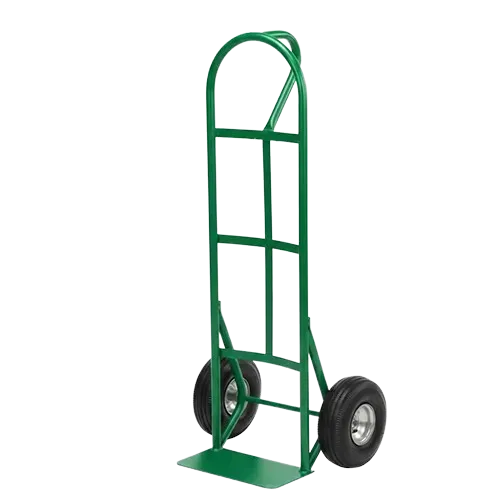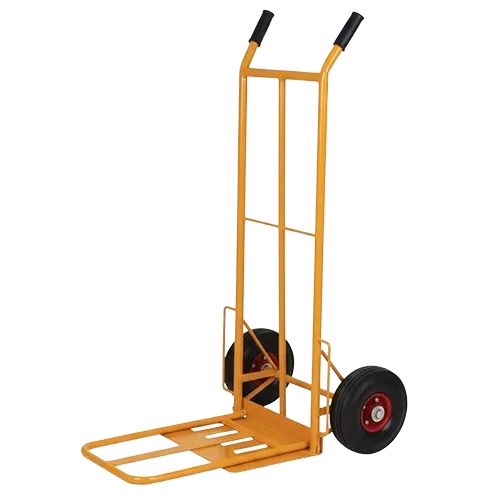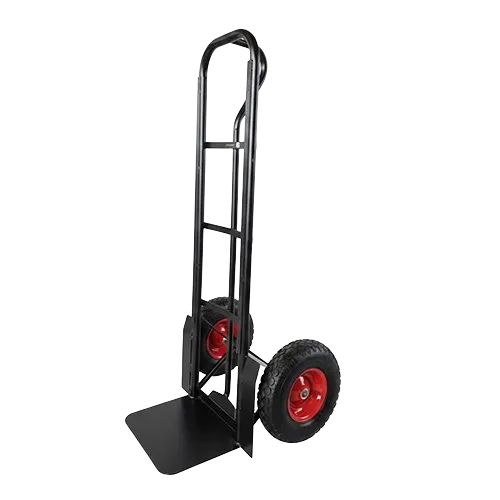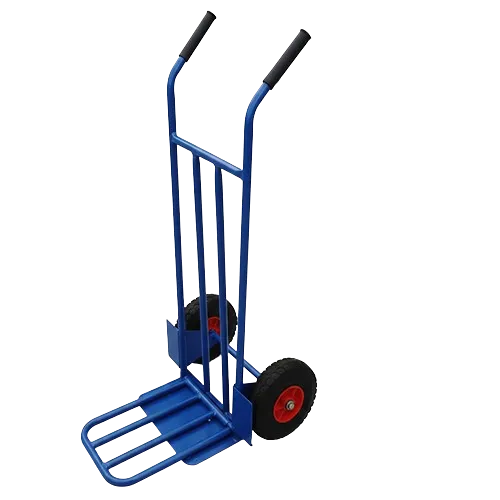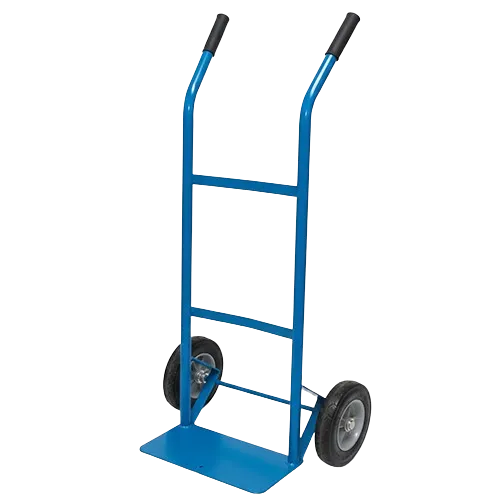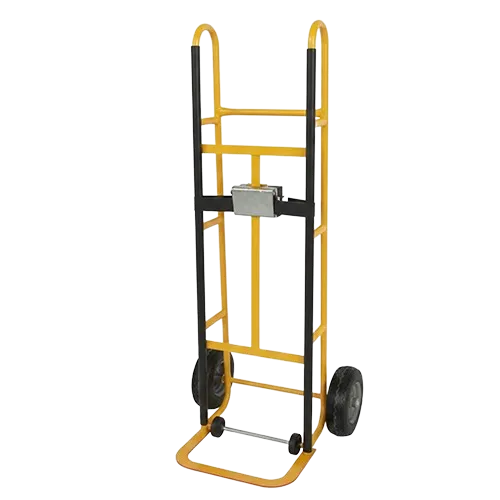
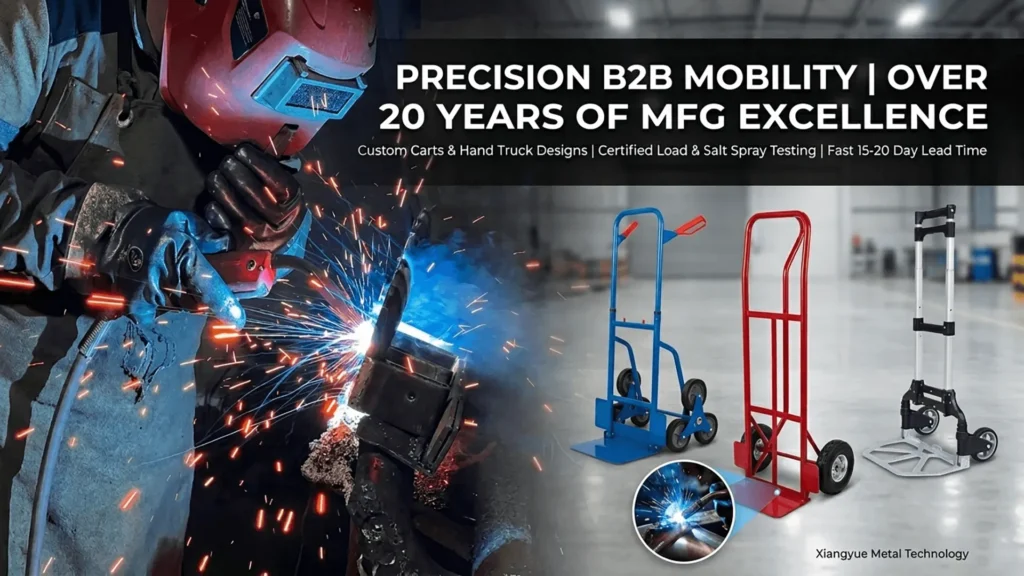
Selling generic, unbranded material handling equipment is a tough business. You compete only on price, and your profit margins are always shrinking. If you want to build a profitable, long-term business in the hardware or logistics industry, you need to build your own brand.
This is where OEM (Original Equipment Manufacturer) production comes in. By partnering with a direct OEM hand truck supplier, you can take high-quality, factory-tested carts and customize them with your own corporate colors, logos, and retail packaging.
However, manufacturing your own brand in China requires careful planning. If you do not specify the right steel thickness, or if you choose the wrong packaging method, your project will lose money.
In this complete guide, we will walk you through the entire OEM hand truck manufacturing process. We use simple, clear English to explain everything from choosing the base frame to ocean freight packing.
1. What is OEM Hand Truck Manufacturing?
Before we start, we need to clarify the difference between OEM and ODM, as many buyers get confused.
- OEM (Original Equipment Manufacturer): The factory already has a proven, tested hand truck design (for example, a 200kg heavy-duty steel cart). You ask the factory to paint it in your specific brand color and put your logo on it.
- ODM (Original Design Manufacturer): You give the factory a completely new engineering drawing. The factory has to build new molds and bend steel in a completely new way just for you.
For 95% of wholesale distributors, hardware store chains, and fleet managers, OEM is the best choice.
💡 The Why: Why is OEM better than ODM for most businesses?
The Why: Speed and Cost. Creating a completely new ODM hand truck takes months of testing. The new frame might bend under a heavy load because it has not been tested in the real world. By choosing an OEM model, you are using a frame that the factory has already tested and perfected over thousands of production runs. You save money on mold costs, you avoid engineering failures, and you can get your branded products to market in just 30 days.
2. Choosing the Right Base Frame and Specs
The first step in working with an OEM hand truck supplier is selecting the base model. Your brand reputation depends entirely on the quality of the metal and the parts. Do not just look at the photo; look at the hard specifications.
When discussing the base model with your factory, you must confirm these three critical areas:
A. Steel Tube Thickness
A hand truck looks simple, but the thickness of the steel tube (gauge) determines if it will survive commercial use.
- Cheap Retail Carts: Use 1.0mm or 1.2mm steel. They bend easily.
- True Commercial Carts: Must use high-tensile carbon steel tubing that is at least 1.5mm thick.
B. The Wheel Setup
Wheels are the number one reason hand trucks fail. You must match the wheel to your customer’s working environment:
- 10-inch Pneumatic Tires (Air-filled): Best for outdoor use, garden centers, and delivery drivers moving over curbs. They provide the best shock absorption.
- PU Solid Wheels (Polyurethane): Best for factory floors and construction sites with nails or glass. They are 100% puncture-proof and never go flat.
C. Bearing Quality
Never accept cheap plastic bearings or unsealed metal bearings. Always specify sealed precision bearings (like 6204 bearings) for your OEM order.
💡 The Why: Why are sealed precision bearings so important?
The Why: A heavy-duty hand truck might carry 200kg (440 lbs). If the bearing breaks, the wheel stops turning, and the cart is useless. Sealed precision bearings have small rubber shields that keep warehouse dust, rain, and mud out of the steel balls inside. This simple specification extends the life of your branded hand truck by years, making your customers highly loyal to your brand.
3. The Custom Branding Process (Making it Yours)
Once you have selected a strong base model, it is time to apply your brand identity. A professional OEM hand truck supplier will offer you several ways to make the product look premium.
Step 1: Pantone Color Matching (Powder Coating)
You do not have to accept the factory’s standard red or blue. You can provide a specific Pantone color code (for example, Home Depot Orange or FedEx Purple). The factory will use industrial electrostatic powder coating to match your color perfectly.
Step 2: Applying Your Logo
There are three main ways to put your logo on a hand truck:
- Silk-Screen Printing: The logo is printed directly onto the steel frame or the toe plate using durable ink. (Most common and cost-effective).
- Metallic Nameplates: A custom metal plate with your logo is riveted onto the back frame. (Looks very premium).
- Laser-Cut Toe Plates: The factory uses a CNC laser machine to cut your brand name directly into the metal of the heavy-duty toe plate.
💡 The Why: Why do we recommend Laser-Cut Toe Plates for heavy-duty models?
The Why: Hand trucks take a lot of abuse. Drivers kick the toe plate, and heavy boxes scrape against it daily. Silk-screen ink will eventually scratch off after a year of heavy commercial use. But a laser-cut logo is physically cut into the steel. It is permanent. Every time the user looks down to load a box, they see your brand name, and it will never fade away.
4. Designing the Packaging (Retail vs. Ocean Freight)
Packaging is the most ignored part of the OEM process, but it directly controls your profit margins. You need to balance how the product looks on a retail shelf with how much space it takes up in a shipping container.
If you are selling to retail hardware stores, you need Custom OEM Color Boxes. The factory will print high-resolution photos of the hand truck, your barcodes (UPC/EAN), and your company information on heavy-duty corrugated cardboard.
However, you must tell the factory to use SKD (Semi-Knocked Down) packing.
In SKD packing, the hand truck frame is flat. The wheels and the axle are removed and packed tightly next to the frame. The end-user simply pushes the axle through the frame and slides the wheels on (a 2-minute job).
💡 The Why: Why is SKD packing the secret to high import profits?
The Why: Ocean freight is expensive. You pay for the volume (CBM) of the shipping container, not just the weight. If a factory ships fully assembled hand trucks, they take up too much empty air. You might only fit 400 assembled units in a 40’HQ container. With SKD flat-packing, the boxes are perfect rectangles. You can dense-pack up to 1,100 to 1,500 units into that exact same container. SKD packing slashes your per-unit shipping cost, allowing you to beat your competitors on retail price while maintaining a high profit margin.
5. Factory Quality Control (QC) Protocols
Your brand is only as good as your factory’s Quality Control. When you put your name on a product, you are taking responsibility for its safety. A good OEM hand truck supplier does not just build fast; they test rigorously.
Before you pay the final balance for your bulk order, ensure the factory performs these three tests:
- Destructive Load Testing: The factory must place weights on the custom hand truck that exceed its rated capacity (e.g., putting 300kg on a 200kg rated cart) to ensure the frame does not bend or collapse.
- Weld Penetration Checks: Especially at the critical joint where the toe plate meets the vertical frame. Modern factories use robotic welding to ensure every weld is deep and consistent without weak spots.
- Salt Spray Testing: Testing the powder coating against rust.
💡 The Why: Why demand a 48-Hour Salt Spray Test?
The Why: Many hand trucks are stored outdoors or in damp distribution centers. If the factory uses cheap, thin liquid paint, the steel frame will start rusting in just a few weeks. A 48-hour salt spray test is an extreme laboratory environment that simulates months of exposure to rain and salty air. Passing this test proves that your branded powder coating is industrial-grade and will protect the steel frame from corrosion.
6. Understanding MOQs (Minimum Order Quantities)
When you buy standard, unbranded products, a factory might let you buy 50 pieces. But when you want to start OEM manufacturing, the rules change.
Most direct Chinese manufacturers will require an MOQ of 300 to 500 pieces per custom model.
If you are a new buyer, this might sound like a lot of inventory. But it is a standard business requirement in the manufacturing world. If you find a trading company on Alibaba that offers to do “OEM” for just 20 pieces, be very careful. They are likely just putting a cheap sticker on a low-quality stock item.
💡 The Why: Why do real factories strictly enforce a 500-piece MOQ for OEM?
The Why: Factory setup costs. To produce your specific Pantone color, the factory has to stop their powder-coating line, clean out the old paint, and load your custom color. For custom color boxes, printing companies in China also require minimum runs. If the factory only makes 50 pieces, the labor and setup time cost more than the materials. The 500-piece MOQ ensures the factory production line runs efficiently, which is exactly how you secure a rock-bottom, factory-direct wholesale price.
7. How to Evaluate an OEM Hand Truck Supplier
Finding a supplier online is easy. Finding a reliable partner is hard. A bad supplier will delay your shipments, ignore your quality complaints, and ruin your seasonal sales.
Here is a checklist to evaluate if a Chinese OEM hand truck supplier is qualified to handle your brand:
- Are they a real factory? Look closely at their main product categories. If they produce hand trucks, wheelbarrows, and casters, they are a professional material handling factory. If they also sell garden hoses, power tools, and office chairs, they are a trading company (middleman).
- Do they have ISO 9001 Certification? This proves they have a standardized quality management system, not just a messy workshop.
- Communication Speed: Send them a technical question about wheel bearings or SKD packing dimensions. Do they reply clearly within 24 hours in professional English? Poor communication during the quoting phase means terrible communication during production.
If you are ready to start building your own brand of heavy-duty material handling equipment, you need a factory partner that understands international standards, high-density container packing, and strict quality control.
👉 Click Here to Contact Our Engineering Team and Start Your OEM Project Today
💡 The Why: Why should you request a live video call with the factory floor?
The Why: In the digital age, photos and PDF catalogs can be easily copied. A live video call (via WhatsApp or WeChat) is the ultimate truth-teller. A real factory manager will gladly walk out onto the production floor with their phone to show you the robotic welding machines, the powder coating lines, and the assembly workers. This builds immediate trust and proves you are dealing directly with the source.
8. The OEM Production Timeline (What to Expect)
To help you plan your inventory and cash flow, here is the standard timeline for a new OEM hand truck order:
- Week 1: Specification & Quoting. You confirm the steel thickness, wheel type, color, and SKD packaging. The factory provides a final FOB price.
- Week 2-3: Sample Production. The factory builds one prototype in your custom color with your logo. They send you detailed photos and videos (or ship the physical sample to your country via DHL/FedEx) for your final approval.
- Week 4-6: Mass Production. Once you approve the sample and pay the deposit, the factory buys raw steel, paints the frames, prints the color boxes, and assembles the units. (Lead time is usually 20-30 days).
- Week 7-10: Ocean Shipping. The container is loaded at a Chinese port (like Qingdao) and spends 15 to 30 days crossing the ocean to your country.
Conclusion
Building your own brand through OEM manufacturing is the ultimate way to secure your local market share and maximize your profit margins.
By taking control of the specifications—demanding 1.5mm steel, precision wheel bearings, and extreme salt spray testing—you guarantee that your product will outlast cheap competitors. Furthermore, by utilizing smart SKD flat-packing, you drastically lower your ocean freight landed costs.
The key to all of this is finding a direct, experienced OEM hand truck supplier in China who acts as your long-term manufacturing partner, rather than just a one-time seller. Take the time to evaluate their production lines, ask the hard engineering questions, and start building a brand that hardware stores and logistics fleets can trust.